

You have a handful of people, several active clients, deadlines stacked on top of each other, and new work coming in. Everyone is busy. The agency is making money. But the thought of taking on one more client feels like a breaking point.
The obvious answer seems to be hiring. Add another person, spread the work around, create more capacity.
But hiring isn't always the right first move. Not because you don't need the help eventually, but because adding people to a messy workflow doesn't fix the mess. It just gives you more people working inside a messy system.
Before you post that job listing, it's worth looking at where your existing capacity is actually going. Because in most small agencies, a surprising amount of time and energy is lost to things that have nothing to do with the work itself.
Why Small Agencies Hit Their Limit So Quickly
A small agency with five people can feel overloaded with ten clients. A larger agency with thirty people can feel overloaded with fifty clients. The ratio isn't the problem. The problem is that as the number of clients and projects increases, the coordination overhead increases too.
Every new project adds:
-
Communication threads
-
Client relationships to maintain
-
Feedback loops to manage
-
Deadlines to track
-
People to coordinate
This overhead doesn't scale linearly. At some point, the time spent managing work starts to rival the time spent doing it.
This is the capacity ceiling that small agencies hit. It's not that the team can't do the work. It's that the team is spending too much of its time figuring out what to work on, where things stand, and what needs to happen next.
The Hidden Cost of Managing Too Many Projects at Once
When several clients are active at the same time, the friction isn't obvious. It shows up in small, repeated moments:
-
Someone asks "where are we with this project?" and the manager has to check three different places to answer
-
A client request comes in and someone has to figure out which project it belongs to
-
A team member finishes a task and has to ask what to work on next
-
Feedback arrives and gets lost in an email thread
-
A deadline approaches and nobody realized the work was blocked
These moments seem small. But they happen dozens of times a day across a small team. Multiply that by a week, by a month, and you've lost a significant amount of productive time.
The work isn't the problem. The friction around the work is the problem.
Where an Agency Loses Capacity Without Realizing It
Let's look at where that capacity actually disappears.
Information Being Scattered Everywhere
Project details live in email. Client feedback is in Slack. Tasks are in a spreadsheet. Deadlines are in someone's calendar. Assets are in a shared drive. Status updates are in a weekly meeting.
When information is scattered, finding it takes time. Every time someone needs to know something, they have to search. And when they can't find it, they ask someone else. That someone else has to stop what they're doing to answer.
This is a tax on the entire team. It's invisible because it's just "how we work." But it's expensive.
The Manager Becomes a Human Dashboard
In many small agencies, the project manager or agency owner becomes the central source of truth. They know what every client needs, what's been done, what's waiting, and what's coming next.
The problem is that this doesn't scale. As projects multiply, the manager spends more and more time answering questions and less time on actual work that moves projects forward.
Worse, when the manager is unavailable, work slows down. Decisions wait. Questions go unanswered. The team loses momentum.
Work Gets Stuck Without Anyone Noticing
A project is waiting on client feedback. Another is waiting for assets from a third party. A third is blocked because two team members have conflicting priorities.
When work gets stuck, it often sits there quietly. Nobody is working on it, so nobody notices that it's stalled. Days pass. Suddenly the deadline is close and the work hasn't progressed.
This is one of the biggest capacity drains in small agencies. The team is busy, but some projects aren't moving. And because nobody has a clear view of what's blocked, the problem goes unnoticed until it's urgent.
Constant Switching Between Clients and Projects
A small agency team might work on five different client projects in a single day. Each switch costs time and mental energy. You have to remember where you left off, recall the context, and get back into the right headspace.
This switching isn't just inefficient. It's exhausting. And it creates a sense of busyness that doesn't always translate to progress.
Creating One Clear View of Clients, Projects and Work
The first step to managing more projects without growing the team is getting visibility. You need a single place where everyone can see what's happening across every client and project.
This isn't about having a to-do list. It's about having a complete picture of:
-
Which projects are active
-
What stage each project is in
-
What tasks are assigned to whom
-
What's waiting on the client
-
What's blocked and why
-
What deadlines are approaching
-
What needs attention next
When this information is visible to the whole team, several things happen:
-
People stop asking "where are we?" because they can see it themselves
-
Managers spend less time answering status questions and more time on actual work
-
Blocked work gets spotted early and can be unblocked
-
The team can prioritize more effectively because they can see everything at once
This visibility alone can create meaningful capacity. Not by making people work harder, but by making it easier to work on the right things.
Making Ownership and Priorities Obvious
When everyone can see what needs to be done, the next question is who is responsible for each piece of work.
In small agencies, ownership often gets fuzzy. Multiple people might be involved in a project, but nobody is explicitly accountable for moving it forward. Tasks get "handled" by whoever has time, which means they sometimes don't get handled at all.
Clear ownership means assigning one person to each task or project component. Not multiple people. One person who is responsible for ensuring it gets done.
This doesn't mean they do all the work. It means they own the outcome. If it's blocked, they escalate. If it's delayed, they communicate. If it's done, they confirm.
When ownership is clear, work moves faster. People know who to talk to about what. Responsibility doesn't drift.
And when the team has clear priorities, they know what to focus on first. This reduces the mental overhead of constantly deciding what to work on next.
Separating Active Work from Blocked or Waiting Work
One of the most useful distinctions a small agency can make is separating work that's actually moving from work that's stuck or waiting.
When everything looks like a task, everything looks the same. But there's a big difference between:
-
Work you're actively doing right now
-
Work that's waiting on the client or someone else
-
Work that's blocked and can't progress
-
Work that's scheduled but not urgent
If you treat all tasks the same way, you'll spend too much time checking on work that isn't actually moving and not enough time on work that needs to happen right now. A simple approach: for each project, mark its current status. Active, waiting, blocked, scheduled. Update it when things change. This gives the team an instant view of where every project stands, without having to dig into details.
Reducing Interruptions and Unnecessary Status Checking
When the team has to constantly ask for status updates, it creates interruptions. Each interruption costs the person being interrupted time and focus. This is where visibility helps directly. When project status is visible and up to date, people don't need to ask. They can look it up themselves. The information is there when they need it, without disturbing anyone.
This might seem like a small thing. But in a small agency, where everyone is already stretched thin, reducing interruptions can create meaningful breathing room.
Where KaamFlow Fits
Agencies often reach for spreadsheets or general-purpose task tools to manage their work. These can work for a while. But as the number of clients and projects grows, the cracks start to show.
This is where a purpose-built platform like KaamFlow comes in.
KaamFlow is designed to give small agencies a single place to manage multiple clients, projects, tasks, and deadlines. It's built around the reality that agency work involves different clients with different needs, timelines, and people.
Rather than scattering project information across emails, spreadsheets, and chat tools, KaamFlow keeps it together in one place. Each client has their own projects. Each project has its own tasks. Each task has an owner, a deadline, and a status.
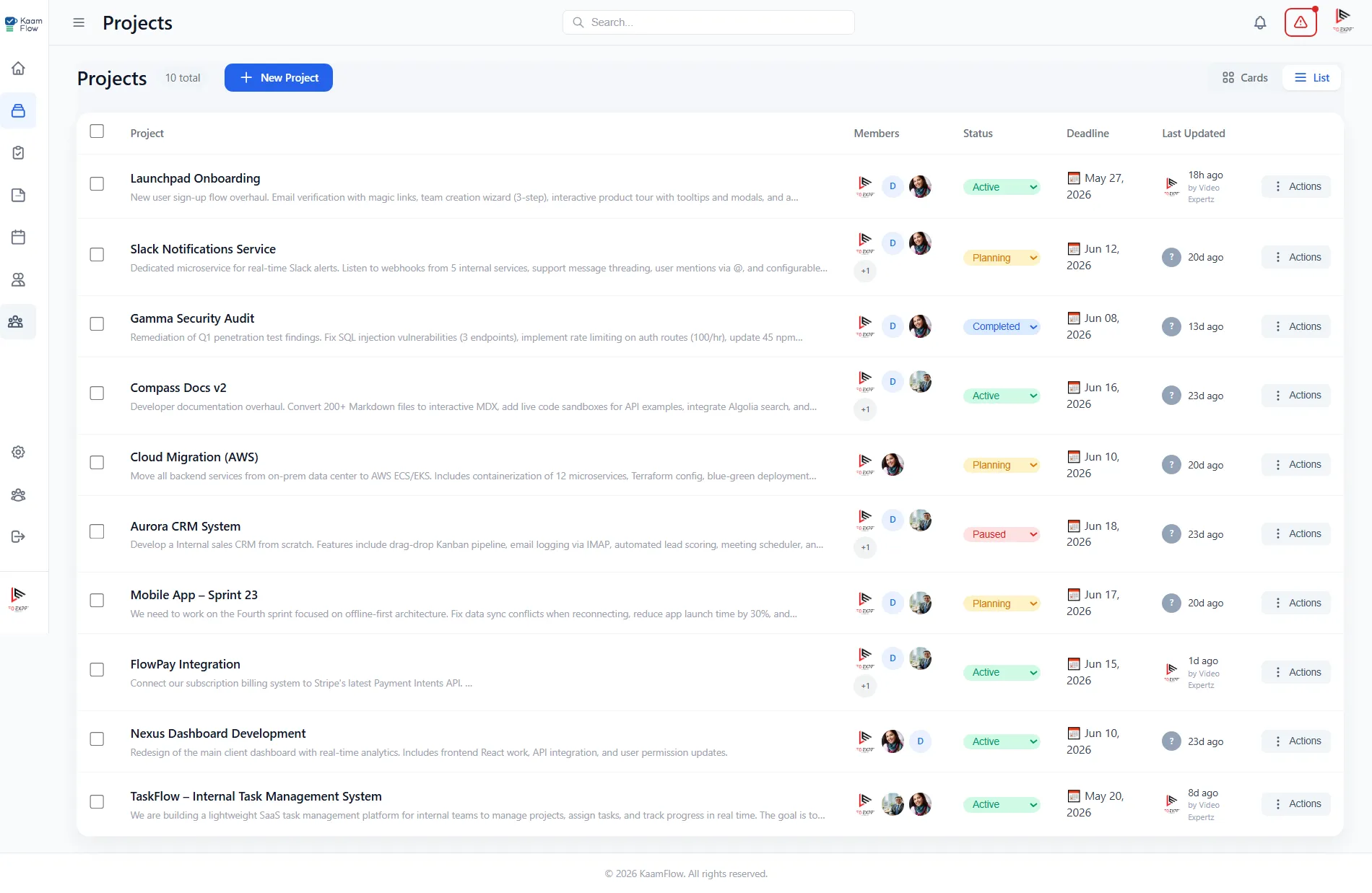
The value isn't in having a place to store tasks. The value is in giving the whole team a clear view of what's happening:
-
What's assigned to whom
-
What's waiting on the client
-
What's blocked
-
What deadlines are approaching
-
What needs attention next
When the team can see all of this without having to ask, the coordination overhead drops. Managers spend less time answering status questions. Team members spend less time figuring out what to work on. And the agency can handle more projects with the same number of people.
This is why KaamFlow matters for small agencies. Not because it magically creates capacity, but because it removes friction that was consuming capacity that already existed.
Knowing When Better Organization Is Enough and When You Genuinely Need More People
Here's an important point: better workflow and project visibility are not substitutes for having enough people. If your team is genuinely at capacity with the actual work required, no amount of organization will fix that.
The key is knowing the difference.
If your team is spending too much time searching for information, answering status questions, and managing coordination overhead, there's likely capacity being lost. Improving visibility and workflow can reclaim that capacity.
If your team is working efficiently, doing meaningful work for most of the day, and still can't keep up with the volume, you need more people. That's not a workflow problem. That's a capacity problem.
The mistake many agencies make is adding people before they've examined their workflow. They hire someone, only to find that the new person gets pulled into the same inefficient system. The workload remains overwhelming, just with an extra person.
Taking time to improve workflow before hiring means that when you do add someone, they join a system that actually works. Their capacity isn't wasted on friction. They can contribute meaningfully from day one.
Conclusion
A small agency can often handle more work without immediately hiring more people. Not by making everyone work harder, but by reducing the friction around the work itself.
When project information is visible, clear, and accessible to the whole team, several things happen:
-
Less time is spent searching for information
-
Fewer interruptions for status updates
-
Blocked work gets spotted early
-
Priorities are clear
-
Managers spend less time coordinating and more time on work that matters
This doesn't mean you'll never need to hire. It means that before you hire, it's worth looking at where your existing capacity is going. Find the friction. Remove what you can. Then you'll know what capacity you actually have and what you genuinely need.
That's how small agencies grow. Not by throwing more people at a broken system, but by building a system that lets the people they already have do their best work.